Now or Next Year?

Emma Jenkings • 28 November 2023

What happens if you delay in resolving conflict?
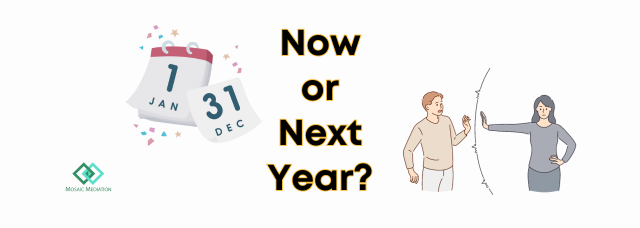
It can be an unpredictable time in the mediation calendar right now. As organisations gear up for various leave requests and parties and end-of-year reflections, they make a decision – whether conscious or subconscious… To address an issue between team members before the Christmas season or wait until the New Year.


I can see the dilemma because it is a busy and often chaotic time of year. It takes a bit of organisation and time to find the right person to manage the conflict resolution process. So, it could seem like there is just no capacity to deal with it in this season.


From my experience, however, when someone is finding it tough to interact with another person – or group of individuals – at work, delay in resolving the issue takes up a lot of their mental capacity and will impact the situation negatively in other ways too.


Thankfully, I am glad to see the blocked out mediation days in my diary being filled by organisations who are choosing to tackle the situation proactively NOW. Why am I so opposed to delay?


Delay is NOT a friend of conflict resolution.


Though time may help cool emotions down after an argument or series of difficult interactions, too much time will often aid in embedding beliefs about what happened and assumptions about intentions.


Delay will often allow time for those at the core of the situation to speak with others about it. Some of whom may offer wise counsel, but we know that when most people go home and tell their family or friends about what happened, they are likely to be offered biased advice and support. Any initial feelings of being treated 'unfairly' will be magnified.


And any part that individual may have played in the breakdown in communication or trust is likely to be brushed over or justified by well-meaning loved ones.


The inevitable consequence of this is that the individual is less likely to be open to alternative perspectives to the one they feel more certain about over the time that has elapsed.


Delay is NOT a supporter of wellbeing.


People’s feelings and thoughts are not put on pause when away from work. Although for those slightly outside of the core concerns, they can put it to one side while on holiday or ‘away from my desk’, for those in the middle of it, there is no reprieve.


Conflict in the workplace is a key contributor to elevated feelings of anxiety. For those who already experience poor mental health, difficult relationships at work will likely aggravate their symptoms further. It is a rare situation for me to hold a workplace mediation without one or more off the participants mentioning the negative impact the situation has had on their sleep or level of stress.


When I am first brought in to mediate, as soon as the participants are aware of the mediation opportunity, they are keen to book a date as soon as possible. They can feel like they are waiting in anticipation for something to bring closure to the situation.


Delay does NOT foster productivity.


While individuals are finding it difficult to interact positively, this has a natural impact on the smooth running of an organisation. Other people end up being the ‘go-between’ or communication is diverted. If the individuals typically work together, they may:

a)      Have to keep working together but with strained communication and the potential for escalating the conflict

b)     Be separated, so others have to take up additional responsibilities

c)      Avoid each other intentionally – meaning that some necessary communication is also avoided, and levels of productivity is affected


When people are finding the strain of the situation too much to be in the middle of, they may feel unable to work under normal conditions – and so choose to work from a different location or avoid being at certain meetings. Or they may be signed off under the stress of what has been going on.


Projects may be delayed, processes may be re-structured, and other team members will feel the effects of the change in atmosphere and processes.


All in all, delay in conflict resolution can be disruptive in terms of productivity, wellbeing and the level of intervention required to resolve the conflict.


I am pleased that this year, Mosaic Mediation have been receiving similar levels of enquiries and the decision to delay was not made by these clients. Perhaps, being able to outsource the mediation, made the decision a little easier. A the mediator resolving the situation and not needing to unravel the consequences of delay, I am very grateful that they decided to tackle the situation proactively and seek conflict resolution without delay.


Emma Jenkings is an experienced and accredited workplace mediator, speaker, communication skills trainer, a trained DISC practitioner and conflict coach. Mosaic Mediation offers conflict resolution services to prevent, manage and resolve conflict including: training, e-learning, DISC profiles and workshops, assertiveness coaching, executive coaching, small business mediation and workplace mediation, and advisory services on fostering peaceful relationships in the workplace. To find out more about the different services available, CLICK HERE.
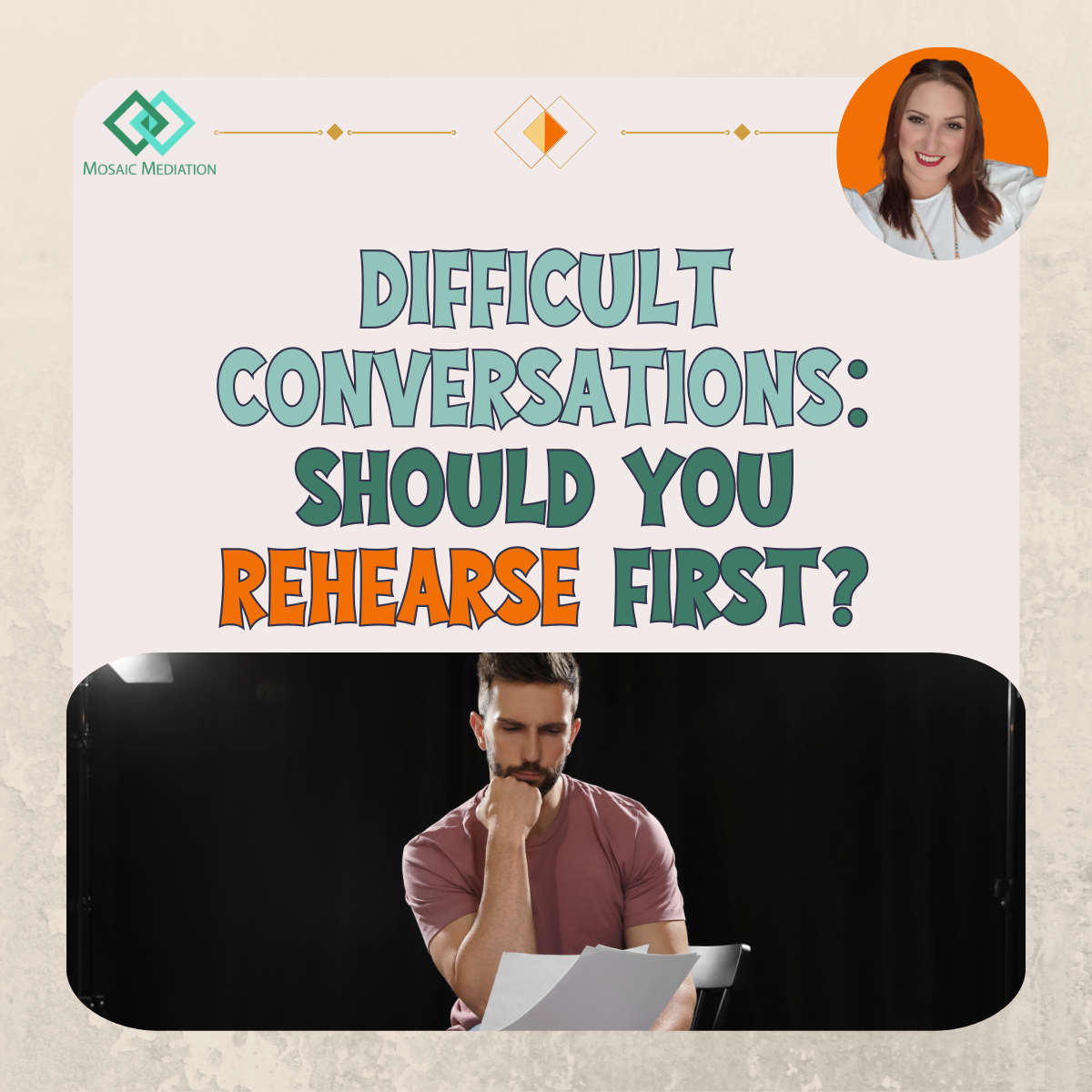
Man looking at a script. Title is 'Difficult Conversations: Should you rehearse first?'
by Emma Jenkings 2 September 2026
We hear it all the time... "the younger generations won't speak on the phone" . (Although, in fairness, I know many an adult across different generations who also avoid phone conversations if they possibly can.) With teenagers of my own, I have thought about this and how far I want to push them to do something that feels uncomfortable. As a SEND mediator, in addition to my workplace mediation practice, I am also very aware that for many young people, the aversion to telephone calls goes beyond slight discomfort requiring upskilling or a confidence boost. I see the benefit of 'live' conversations though. That, unlike with messaging or emails, the speaker has a greater opportunity to convey their intentions and feelings using their tone of voice - body language adds to the communication if involving a videocall or in-person conversation. In my mediator role, I so frequently see small misunderstandings take place that lead to big issues, so anything which lessens the likelihood of that is a positive in my book. Telephone calls are like difficult conversations - people just don't want to have them! Difficult conversations are often avoided because people don't like tension. But, another reason difficult conversations are avoided, just as with telephone calls, is because people are not sure what they will say. Someone may even have tried to hold a tricky yet essential conversation in the past but got thrown off by an unexpected question or response from the other person. Then, this past experience makes them reluctant to go through a similar experience again. The tip I give out the most when people go through coaching due to wanting to be more confident and effective at holding difficult conversations is to prepare for it . Most people need some practice to feel confident on the phone. And in the majority of employed roles that involve a lot of telephone use, a company would provide a script so that any client receives a similar experience, regardless of which individual employee answers the phone. However, some might be concerned that a scripted conversation is likely to feel disingenuous. So, is there anything wrong with rehearsing a conversation beforehand? The last few months, I have done a lot of rehearsing! At the end of this week, I will be delivering my first TedX talk and one of the big challenges with speaking at a 🔴TedX event is to deliver the message without any notes. So, I have been memorising and memorising constantly. At one point, I had done really well at remembering the lines but realised that it sounded 'wooden' and unnatural. I had to take a moment to remember the purpose of what I was saying and how I felt when I first wrote the talk. There is a need - as with many scenarios - to strike a balance between seeming sincere whilst being prepared for a difficult conversation. Depending on the complexity of the conversation, you may find it helpful to prepare in greater detail for that conversation. (You can make use of this planning sheet as a resource . ) There are a few simple principles to consider when preparing for a conversation, so that it comes across as genuine and prepared: Work your way backwards - Take time before the conversation to consider what you want the other person to have heard when they leave. And, what do you want them to do with what they heard? Consider the where, when and how - Timing and context matters. Try to hold a sensitive conversation in a busy place and in a rush and you are unlikely to get a measured response. Have something 'up your sleeve' - Consider a few phrases that you can use during the conversation if you need to pause and process, or if you don't have an answer to a question they ask. This is also potentially helpful if you are going into a conversation with someone who has a particularly authoritative or aggressive communication style; meaning you may need to set boundaries. It is really beneficial to feel confident and clear - and also be genuine - when entering a potentially awkward or difficult conversation. Rehearsal for different outcomes can certainly help with that, especially if you can do that with a someone experienced with navigating such interactions. Simply working through the above three principles means you are likely to feel more prepared regarding what you would like to say, but also how to navigate the conversation when the other person responds too. If you would like coaching support to become a more effective communicator or to manage conflict with confidence, send Mosaic Mediation a message . Emma Jenkings is an accredited mediator, conflict and Peaceful Leadership coach, DISC practitioner, and mediator mentor. You can email any questions or queries to enquiries@mosaicmediation.co.uk .
'Flipping the Drama Triangle' - article by Emma Jenkings, Mosaic Mediation
by Emma Jenkings 8 July 2026
Find out how the drama triangle roles show up in different scenarios – including the workplace - and how to break out of the roles that lead to conflict escalation.
'Keyboard Chaos: Problematic Communication'. Image: Hand typing on a keyboard.
by Emma Jenkings 18 May 2026
Written communication can cause a whole range of issues within a workplace. Discover the consequences of problematic messages between colleagues and tips to improve.
'Ten years of you, my peace and I' - Mosaic Mediation blog
by Emma Jenkings 3 March 2026
Explore how mediation supports mental health in the workplace. Mosaic Mediation reflects on 10 years of conflict resolution and the need to "manage your own peace".
'Communicating without words' - Mosaic Mediation
by Emma Jenkings 13 November 2025
Non-verbal communication can account for up to 93% of communication. Therefore, it is important to understand the impact of non-verbal communication on interactions.
The Power of Yet - Mosaic Mediation - Man looking at finish line flag.
by Emma Jenkings 17 September 2025
It isn't easy to be in that space between desire and the outcome. Hope is the determining factor that motivates people towards the goal of 'resolution' in mediation.
What a difference a day makes - Mosaic Mediation
by Emma Jenkings 22 July 2025
Workplace mediation is a process that can make a tangible difference in just one day of mediation. It is the start of resolving issues and improving relationships.
What is underneath the behaviour? - Mosaic Mediation
by Emma Jenkings 2 June 2025
They say that only a minor amount of communication is verbal - yet what if both non-verbal communication and external behaviours are still only part of the story? This article explores what leads to misunderstandings and miscommunication.
A problem shared... Mosaic Mediation
by Emma Jenkings 28 April 2025
While gossip can feel good at the time, it rarely makes a beneficial difference to a situation. Conflict coaching is a tool that is becoming more commonly used, as individuals and organise recognise the positive impact only a few conflict coaching sessions have on the individual and the dispute situation.
Show More