You may have heard about the
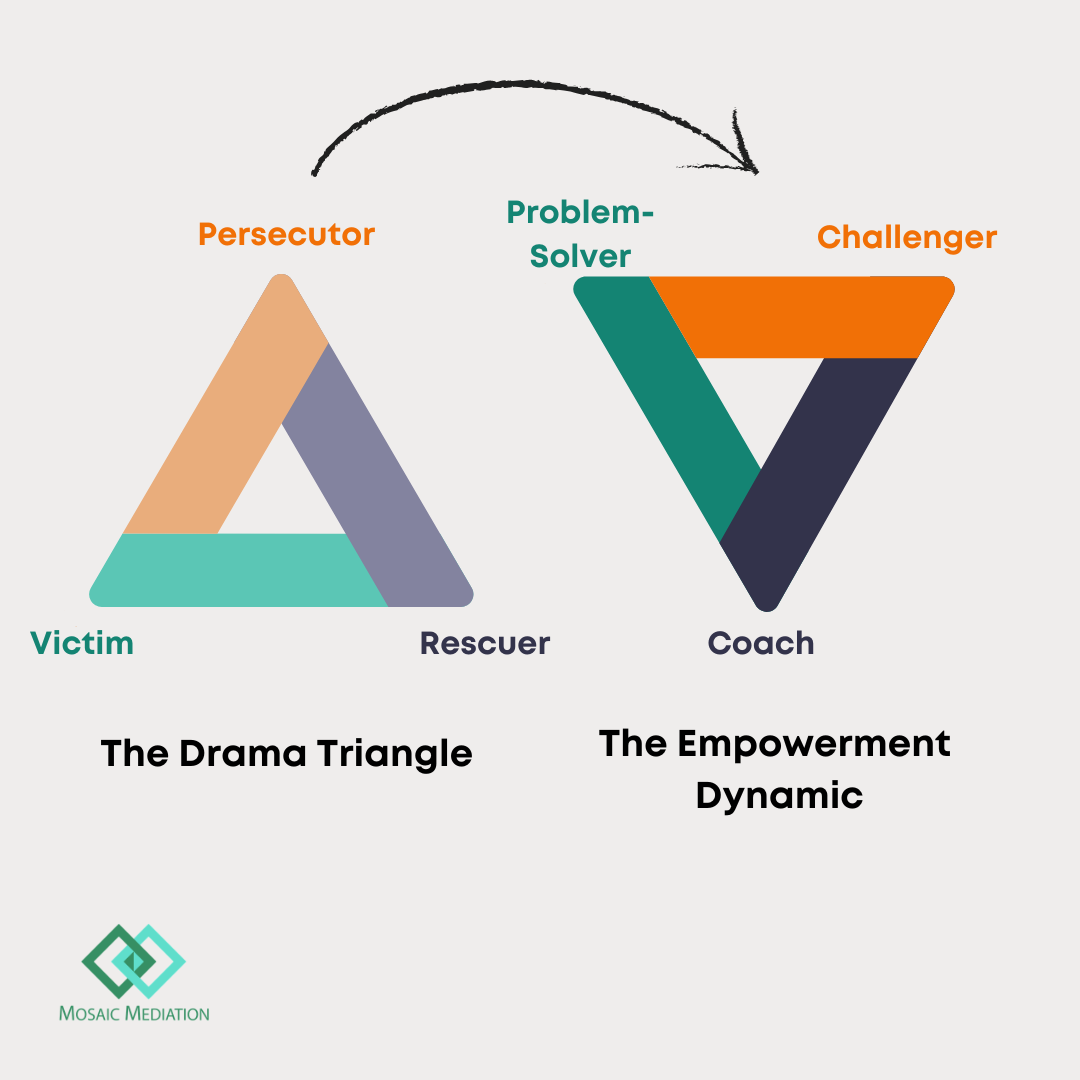
Karpman 'Drama Triangle' – most mediators will know it inside and out! In this article, I aim to clarify how the drama triangle roles show up in different scenarios – including the workplace - and how to break out of the ‘triangle’.
When we talk about the drama triangle with others, it may not take much effort to picture an average conflict situation and pinpoint which people tend to play each of the roles. I can imagine you thinking of people in your family or friendship group as you work through the list!
I am intrigued to know
which role
you naturally lean towards too…? As a summary for you, here are the roles in the Karman Drama Triangle:
1.
Victim – The person who often feels helpless or targeted by others (or life in general!)
2.
Rescuer – The person who swoops in to fix the situation – sometimes without being asked.
3.
Persecutor – The person seen to have instigated the issue, often through blaming or unkind behaviour.
Commonly, what most imagine when thinking of the drama triangle is the most heightened of conflict situations – involving objectively harsh behaviours from one person, someone else being distressed, and the other consoling.
However, it is a misconception to believe the drama triangle only presents itself when conflict is distinctly and overtly apparent.
What if you were to consider more of the day-to-day drama triangles in the workplace or personal setting, that are just as much ‘conflict’ as the more extreme version?
1.
The overwhelmed martyr
– “I have to do everything myself because no-one else will do it and management doesn't support me.”
2. The micromanaging fixer
-
“I’ll just take over this project, so you don't fail. I can save it.”
3.
The blame and shamer
-
“If your team kept up with deadlines, we wouldn't be in this mess.”
As illustrated above, the dynamics of a drama triangle are often very much part of normalised interactions, even if others find them frustrating or annoying at times.
Until you learn to spot the triangle, you will keep solving the same office conflicts over and over again.
In reality, the type of dispute that results in a mediator’s intervention, generally arises when someone switches out of their typical role. For example:
- When the Rescuer becomes the Persecutor – having covered for an underperforming colleague (self-labelled a Victim) so many times, they eventually reach their limit and publicly calls them out in a meeting.
- When the Victim switches to Persecutor – the underperforming colleague now feels attached and makes a complaint about bullying.
- And then the original Persecutor starts to feel like the Victim (of the original Victim).
One of my roles as a mediator, is to understand what the current situation is and the various narratives of those involved as to how we got here. The aim is not to investigate the ‘facts of the case’ but rather to be aware of how the individuals view their participation and the roles of others who were part of the conflict situation.
Most often, individuals quite clearly lean towards a certain role in the drama triangle, but their reactions, at times, have also led them to play more than one role along the way. For example, although one person may have historically believed they were primarily the victim in the story, some of their actions may have led them to be perceived as a persecutor too. And this latter role may not be one they find comfortable acknowledging.
Flipping the Triangle
I truly believe that our behaviours are not fixed and that, therefore, we can change the patterns that are causing frustration, hurt, or communication breakdown. Even if it takes a bit more work for the particularly embedded patterns of behaviour.
When a third party is brought into a dispute involving others, so often their natural instinct is to cheerlead for one person or rescue the whole situation, accidentally keeping the triangle alive as the Rescuer.
A mediator breaks the triangle with the beauty that is
‘neutrality’. A mediator refuses to step into the story nor to validate any of the drama triangle roles but rather encourages parties to step into the ‘Creator’ space instead.
By doing so, the parties to the dispute step outside of their drama role tendencies – and their role as perceived by the other individual – and start looking at the issue at hand, rather than focussing on what the other person ‘did wrong’. So, begins the pathway out of drama toward peace.
If you would like more peace in your
workplace relationships,
contact
enquiries@mosaicmediation.co.uk
to explore the variety of solutions available to enhance communication skills and resolve issues that arise.
Mosaic Mediation has successfully intervened in a variety of complex workplace relationship disputes and develop team member interpersonal skills.