Keyboard Chaos - Problematic Communication
Managing written communication in the workplace.
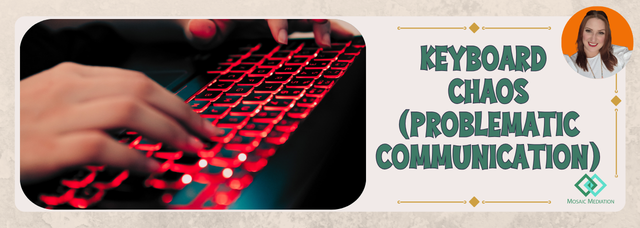
We know that people get brave behind the screen. We call them ‘keyboard warriors’ when describing social media posts or comments that we could not imagine someone verbalising when face-to-face with a person.
However, as written communication is now often the primary form of interaction in the modern 'remote-working' workplace where so much is achieved remotely, businesses are already keenly aware of the impact of problematic correspondence between colleagues on the individual team members and the wider organisation.
Most written communication is likely to be a non-issue, but the problem arises when either a) there is a genuine misunderstanding, or b) the message was delivered carelessly or inappropriately.
Not only does this impact the individuals involved in the exchange, but there is also a ripple effect on the team dynamics and productivity, and when not tackled early on, could lead to an escalation of conflict, during which time the colleagues’ negative perceptions of each other become more entrenched.
Of course, another related concern might be that how someone is communicating with their colleagues might also manifest in how they communicate with clients or customers – or, how their message might be received at least.
Why is this situation becoming such a concern?
There is a widespread acknowledgement that written communication can be easily misinterpreted. However, misinterpretation was somewhat less of a concern in the workplace when written communication was supplemented by in-person interactions. A hastily worded email might be given more benefit of the doubt by the person who received it if their regular interactions in-person with the sender of the message have provided a reassurance of their character and likely positive intentions.
Now, however, the interpretation may primarily be based on how the reader perceives the tone of the message, without further understanding or experience of the message sender beyond previous written communication. And, when colleagues have differing communication styles, a misunderstanding of intent is much more likely.
To reduce the potential for unintended misunderstandings, AI can be a helpful resource to improve written communication, as many employees now will run a message through their chosen AI platform to check how it might be received, before amending and sending the communication. However, AI is not perfect and rarely has all the necessary and nuanced information required to really know how to navigate a tricky dynamic between people.
Also, individuals can now often recognise the pattern of words or phrasing that is used by AI, which may perhaps lead to the receiver questioning the sincerity of the message, and what the views of the sender really are, beyond what they have been guided to say by AI.
An inappropriately worded message from a colleague could be due to a blind spot regarding how that message is likely to be received. Alternatively, of course, it may be that the sender is totally unconcerned with the potential impact of how they phrase things – in other words, they don’t really care.
It may also be that people believe a certain way of behaving or communicating is acceptable to that organisation. When problematic messaging is not perceived to be a problem, it may reduce the sense of responsibility to communicate thoughtfully and appropriately. Of course, this might be particularly influential if senior leaders in the organisation communicate a certain way without clear or perceived challenge.
In some cases, an individual may have a moment of removing their ‘work-appropriate’ filter because of other contributing factors – such as tiredness, work pressure, mental health concerns, or other personal issues or worries from outside work.
The situation can of course be handled swiftly and effectively to reduce the risk of escalation, however, in many cases a team member may not raise their concerns at the first event. Rather, they may have an internal response which then builds over weeks or longer. In the meantime, this is likely to impact their interactions with this person, how they work with them, and how they speak about them.
The most common next step is raising a grievance. Now, as someone who previously worked at the Employment Tribunal and studied Law at university, I am not opposed to the use of grievances when appropriate. However, I often see grievances being utilised with the genuine intention and hope of improving a relational situation, which the grievance process is not really set up to do effectively.
More often than not, my experience indicates that relational situations are negatively impacted by a grievance process – making the possibility of restoring a positive working relationship less likely or, at least, requiring more effort.
So, as with many situations, ‘prevention is better than a cure’ with workplace written communication. I often find that the answer is found within the challenge:
- Challenge 1: Not giving the benefit of the doubt – resulting in misunderstandings.
I would be interested in understanding whether the culture or their working practices enable communication in different forms, so that colleagues get to know each other beyond the written word.
In acknowledging that individuals will have different communication styles, which will influence how they write and interpret messages, how well-informed are they about their communication style and the communication style of others?
Of course, this is not advocating for ambivalence to it. Even with good intentions, there might still be a need to consider the impact of a message or the interpretation (see below points).
- Challenge 2: AI is not always the best advisor.
Humans read between the lines in a way that AI has not yet fully grasped. Most tools can be used effectively or ineffectively. I would be curious about how organisations advise on the use of AI so that it is used as an effective guide, rather than ‘copy and paste’. AI can be help in identifying potential concerns, but it may not be fully reliable for the final edit.
If someone is finding that they are relying heavily on AI to communicate with colleagues, I would also be interested about whether this challenge has been raised with a line manager and what conversations might be appropriate to support that individual.
- Challenge 3: Some people do not care.
What behaviours are considered ‘acceptable’ in your organisation? If communication is noted to be unhelpful or problematic, I would be intrigued about how that is addressed. Saying nothing, improves nothing.
If there a perception that people can communicate without respect or regard for what is appropriate or expected, then that approach to communication is likely to continue. (And, those impacted by it will likely begin to resent any perceived lack of intervention.)
- Challenge 4: Perceived cultural acceptance.
Perception goes beyond what is done.
Even action is taken to challenge inappropriate or problematic communication, if it is perceived by team members that it is the norm or acceptable to communicate a certain way, it is likely to influence how they communicate, particularly if motivated to ‘fit in’.
Of course, this doesn’t mean an individual is absolved of personal responsibility, but it does make it more difficult to apply expectations which don’t seem to match the wider organisational culture.
The more senior leaders embody the expectations of how colleagues communicate, the more likely the rest of the team are to follow suit.
- Challenge 5: Mis-judged moments.
Sometimes people have a ‘bad day’ at work, which includes interactions or communications that they would love to take back when emotions have settled down again. If an organisation’s culture has been nurtured in a way that addresses mistakes effectively but also provides opportunities for reflection and development following a mistake, it is more likely that the situation is resolvable.
It is important to separate intentions from impact. As highlighted previously, even if the intentions were positive and it was just a ‘slip’ in the moment, there may still be an impact on trust with the colleague – or, in some cases, significant harm done, depending on the circumstances for the person who received the communication, or impacted by it.
Ownership and accountability reap much more grace than avoidance or minimisation.
As a mediator, of course, I believe communication is important. When communication is effective, it cultivates better working relationships, improved productivity and organisational growth.
Although there are many tips and techniques that improve how people interact, if I were to break down communication skills training in the workplace for written communication into the two key ingredients from the ‘SCM Model’, a) warmth and b) competence.
If you can aim to write a message which has both warmth and competence, your message is much more likely to be received well.
Now, of course, genuine mistakes happen, and so do misunderstandings. To highlight the key points from the above article, written communication in an organisation works best when the organisation sets expectations, manages expectations, nurtures a positive culture, and develops their team’s communication skills to ensure fewer misunderstandings take place.
(If in doubt, send a mediator in to sort it out!)
Emma Jenkings is an experienced and accredited workplace mediator, SEND mediator, conflict coach, Peaceful Leadership coach, mental health first aider, mediator mentor, and DISC practitioner. Emma founded Mosaic Mediation to support and equip individuals and organisations with the training and techniques to improve relationships at work and beyond.
If you are aware of a situation that could benefit from specialist input, do get in touch via the ‘Contact’ page or by emailing: enquiries@mosaicmediation.co.uk .